

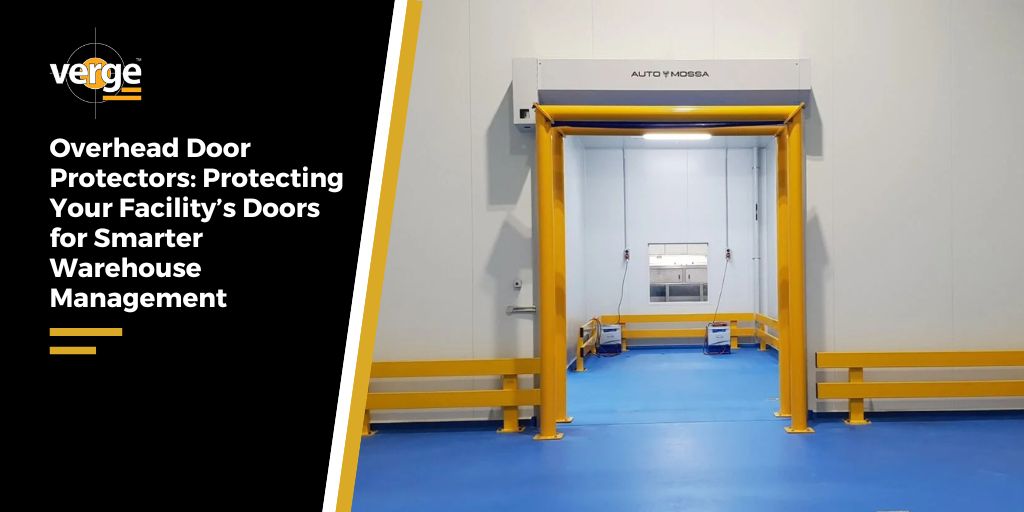
In busy warehouse environments, roller doors & rapid doors are among the most frequently impacted fixed structures and yet they remain one of the most undervalued assets requiring engineered protection.
Whether the operation involves counterbalance forklifts, reach trucks, walkie stackers, pallet movers or heavy rigid vehicles, any uncontrolled impact to an overhead door frame can immediately disable operations, trigger costly downtime, create WHS non-compliance and expose the Person Conducting a Business or Undertaking (PCBU) to foreseeable risk obligations under the Work Health and Safety Act 2011.
Overhead Door Protectors (ODPs) including bollards, structural steel guards, polymer impact rails and engineered door-frame protection systems represent an essential risk-control measure that strengthens the facility’s ability to maintain safe movement, preserve structural assets and mitigate predictable human-factor errors.

Under WHS legislation, a Person Conducting a Business or Undertaking (PCBU) must ensure, so far as is reasonably practicable, that fixed and temporary structures within a facility are safe for use (WHS Act 2011, s19).
This includes:
Overhead doors form part of the building structure, vehicle access systems and emergency access pathways; therefore, any damage can constitute a breach of WHS duties if not adequately controlled.

Overhead doors are repeatedly exposed to hazards such as:
When an overhead door is struck, consequences may include:
According to global warehouse incident data, nearly 70% of fixed-structure impacts involve forklift contact, with overhead doors listed as one of the top three impact points. Example (OSHA Materials Handling Review and WorkSafeBC Warehouse Safety Report 2022).
In October 2025 the NSW government the Minns Labor Government launched a month-long compliance blitz campaign with a specific focus on forklift safety with over 250 SafeWork inspectors travelling across regional and metropolitan NSW to conduct unannounced checks.
The purpose of Overhead Door Protectors (ODP) and the outcomes they achieve in industrial facilities:

Although overhead-door-specific crash testing is less common than general barrier testing, a substantial body of regulatory guidance and impact research confirms the effectiveness of engineered barrier systems in protecting doorways and building structures from mobile-plant collisions.
WorkSafeBC’s Lift Truck Pedestrian and Structural Impact Hazard Study identifies building openings and overhead doors as high-frequency collision points within warehouses and distribution centres.
Similarly, OSHA’s guidance on preventing injuries and property damage from forklift impacts recommends the installation of physical barriers at doors, racking and building perimeters to reduce both injury risk and structural damage
Technical research published by SICK Sensor Intelligence highlights doorway and door-frame collisions as a recurring pattern in mobile-plant incidents, reinforcing the need for engineered protection at these locations
In Australia, both WorkSafe Queensland and SafeWork NSW identify fixed structures, particularly doorways and loading bay access points as high-risk collision zones that require engineered controls such as guards and bollards to meet traffic management and mobile-plant safety obligations.

When choosing an Overhead Door Protector (ODP) system, consider:
Overhead Door Protectors are not merely an optional operational upgrade, they are a reasonably practicable, evidence-based, and legally defensible risk-control measure for warehouses seeking to eliminate mobile-plant impact hazards. In an environment where a single forklift collision can shut down an entire production line, the decision to install engineered door protection is not just operationally prudent; it is a core WHS compliance obligation.
Protect the structure. Protect the workflow. Protect the people.