

In many workplaces, structural columns and downpipes are positioned in areas where vehicles, forklifts, pallet jacks, trolleys and mobile plant routinely operate. While these structures may appear robust, they are often highly vulnerable to impact. Damage to a structural column can compromise the integrity of a building, while damage to a downpipe can result in water ingress, slip hazards, costly repairs and operational disruption.
Unfortunately, organisations frequently overlook these hazards until an incident occurs.
Under Australian Work Health and Safety (WHS) legislation, a Person Conducting a Business or Undertaking (PCBU) has a primary duty to eliminate risks to health and safety, or where elimination is not reasonably practicable, minimise those risks so far as is reasonably practicable. Installing appropriate column and downpipe protection is a practical engineering control that demonstrates proactive risk management rather than reactive maintenance.
Every workplace contains fixed structures that become potential impact hazards where mobile equipment operates.
Common examples include:
These structures are commonly struck by: Forklifts, Reach trucks, Order pickers, Delivery vehicles, Heavy vehicles, Mobile plant, Pallet jacks, Elevated Work Platforms and Trolleys
Many impacts go unreported because the collision appears “minor. ” However, repeated low-speed impacts gradually weaken structures and increase future risk.
Structural columns carry significant building loads.
A single forklift collision may; deform the column, reduce structural capacity, compromise welds, crack concrete footings or create hidden structural damage
The consequences can include:
The cost of installing protection is insignificant compared with the consequences of structural failure.
Downpipes frequently run alongside warehouse columns and building walls.
Although not structural members, damaged downpipes create secondary hazards such as; water leaks, slippery surfaces, mould growth, damaged stock, electrical hazards, deterioration of building materials, corrosion and drainage failures.
Where forklifts regularly reverse into loading areas, downpipes are particularly vulnerable.
Protective barriers significantly reduce these risks.
There are numerous engineered solutions available.
Suitable for: warehouses, manufacturing facilities or logistics operations. They absorbs forklift impacts, protects structural members and are highly durable.
Manufactured from high-impact polyethylene. Advantages include: corrosion resistant, lightweight, highly visible, energy absorbing and low maintenance.
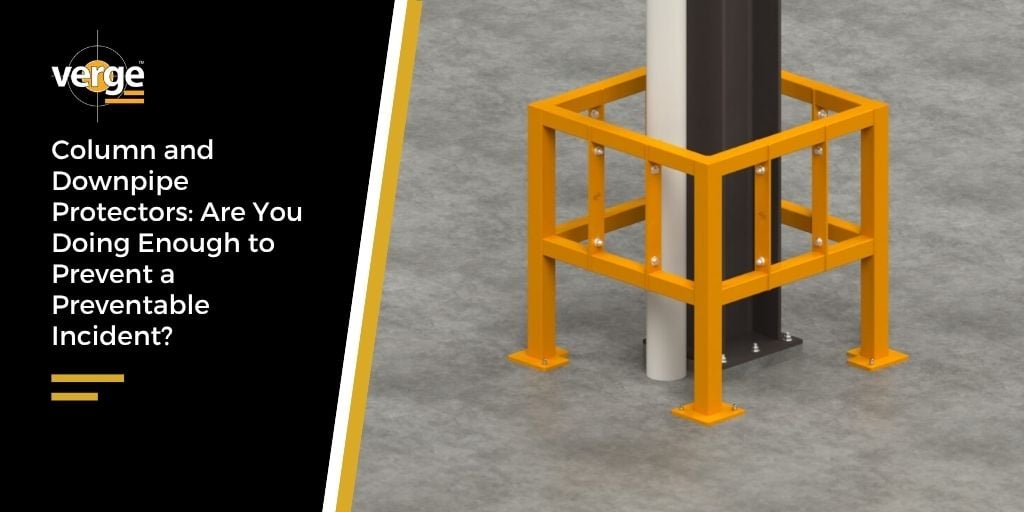
Installed around vulnerable structures. Available as: fixed, removable, impact-rated and concrete-filled. Ideal for: building entrances, roller doors, electrical cabinets and gas meters.
Provide continuous protection along walls. Often installed: around offices, warehouse walls, or pedestrian walkways.
Designed specifically to shield: stormwater pipes, fire services and, communication conduits. These guards absorb impacts before contact with the pipe occurs.
Selection should be based on:
A generic solution may not adequately protect every workplace. Each installation should form part of the organisation’s documented risk assessment.
Column protection should never be viewed as a standalone solution.
It should integrate with a comprehensive Traffic Management Plan incorporating:
The objective is to reduce both the likelihood and consequences of vehicle collisions.
Protective barriers require regular inspection.
This is the risk management process required to meet the legal obligations established under the Model Code of Practice.
Inspection should verify: distortion, loose anchors, corrosion, cracks, impact damage, missing components, movement and deterioration
Following any significant collision, engineering assessment may be necessary before the barrier is returned to service.
Inspection outcomes should be recorded as part of the workplace maintenance program.
Many organisations install barriers incorrectly.
Common deficiencies include:
These deficiencies reduce the effectiveness of the engineering control.
Following a serious workplace collision, regulators may examine: risk assessments, traffic management plans, incident history, maintenance records, consultation records, inspection records, engineering documentation and training records.
Where reasonably practicable engineering controls were available but not implemented, organisations may face: Improvement Notices, Prohibition Notices, enforceable undertakings, significant financial penalties or/and prosecution.
Officers may also be required to demonstrate they exercised due diligence by ensuring appropriate resources were available to manage these foreseeable risks.
Safety professionals should consider the following actions:
Effective column and downpipe protection provides significant operational benefits.
These include: reduced property damage, improved workplace safety, lower repair costs, reduced insurance claims, fewer operational interruptions, protection of critical infrastructure, improved asset life, demonstration of due diligence, improved safety culture and stronger compliance with WHS legislation.
Most importantly, these engineering controls assist in preventing incidents that have the potential to cause catastrophic injury.
Column and downpipe protectors are often viewed as minor infrastructure items. In reality, they represent an important engineering control within an effective workplace traffic management system.
Every impact that is prevented protects not only the building, but also workers, visitors and business operations. Organisations should not wait for a collision, regulatory inspection or insurance claim before implementing suitable protection.
Safety professionals should evaluate all areas where mobile plant interacts with fixed structures and ensure that appropriate engineering controls are installed, inspected and maintained. By integrating column and downpipe protection into broader traffic management strategies, PCBUs can demonstrate compliance with their legislative duties while reducing the likelihood of costly and potentially life-threatening incidents.
Preventing a collision is invariably more effective and considerably less costly than responding to its consequences.

*Applies to online orders only. *Cannot be used in conjunction with any other offer **Must purchase within 3 months of receiving the voucher ***Minimum order $1000
"*" indicates required fields
If you need assistance with selecting a product, would like a quote or want to ask a question please call our friendly team on 1800 765 539