

When vehicles, forklifts, trucks, mobile plant and pedestrians share the same workplace, speed is a safety issue; not simply a traffic-management issue.
A vehicle travelling too quickly through a workplace can turn an otherwise manageable situation into a serious incident within seconds. A pedestrian stepping into a traffic route, a forklift emerging from a blind corner, a delivery vehicle entering a loading area or a worker crossing a driveway can all create circumstances where the speed of a vehicle becomes the critical factor between a near miss and a serious injury.
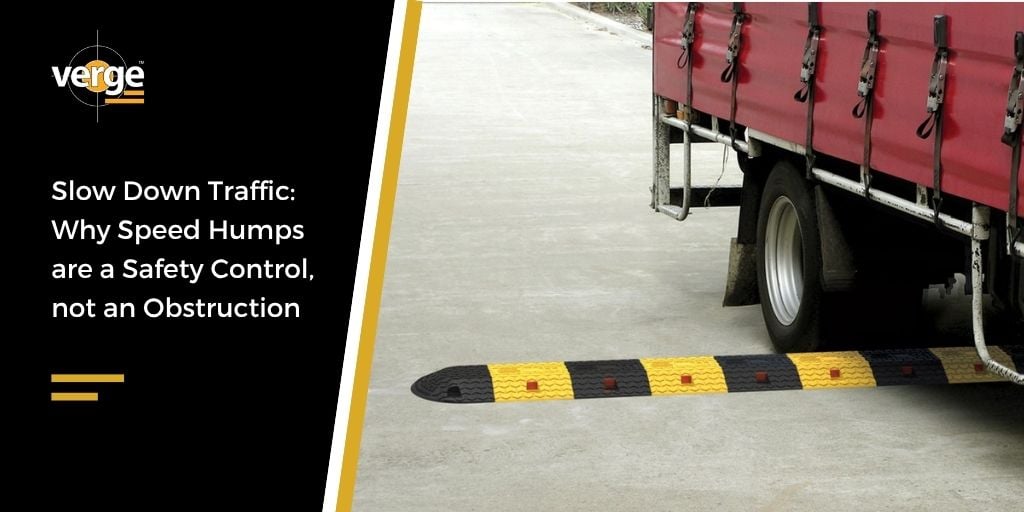
This is why speed humps and other traffic-calming measures should not be dismissed as an inconvenience to drivers.Properly selected and implemented, they can form part of an engineered traffic-management system designed to reduce vehicle speed and the consequences of vehicle-pedestrian interaction.
SafeWork NSW expressly identifies speed reduction and traffic-control measures, including speed humps, chicanes and rumble strips, as controls that can reduce vehicle speed in workplaces. It also states that lower speeds may be appropriate where pedestrians are present or where forklifts and vehicles share a traffic route.
The starting point is not the question: “Do we need a speed hump?”
The starting point is: “What is the risk created by vehicle movement at this workplace and what is reasonably practicable to eliminate or minimise that risk?”
Under section 19 of the Work Health and Safety Act 2011 (NSW), a person conducting a business or undertaking (PCBU) has a primary duty to ensure, so far as is reasonably practicable, the health and safety of workers and that other persons are not put at risk by work carried out as part of the business or undertaking.
This duty extends beyond employees. Visitors, contractors, delivery drivers, customers and other people who enter the workplace may also be exposed to traffic hazards.
SafeWork NSW describes traffic management as an important workplace safety issue wherever vehicles, mobile plant and pedestrians interact, noting that inadequate traffic management arrangements can result in serious injury or death.
Therefore, a business cannot simply rely upon a sign stating “10 km/h” and assume the risk has been controlled.
A speed limit is an instruction. A speed hump is a physical intervention that can help make compliance more likely.
Vehicle speed affects both the likelihood and potential severity of an incident. As speed increases, the distance required to react and stop also increases. More importantly, the consequences of a collision generally become more severe as impact speed increases. This is particularly important in workplaces because the traffic environment is often fundamentally different from a public road.
A workplace may contain: forklifts and mobile plant; heavy vehicles; delivery vehicles; light vehicles; pedestrians; contractors; visitors; loading and unloading activities.
The risks could include: blind corners; reversing vehicles; narrow traffic routes; intersections; parking areas and changing work activities.
These risks can occur within a relatively confined area.
SafeWork Australia recommends that businesses identify areas where people and vehicles interact, consider blind spots and visibility, examine vehicle types and movement patterns, and review incidents and near misses when managing traffic risks.
This is where speed becomes significant. A driver travelling at an inappropriate speed has less opportunity to identify a hazard, react and stop before an interaction occurs.
One of the fundamental principles of WHS risk management is to consider controls according to the hierarchy of control.
Engineering controls are generally preferable to relying exclusively on administrative controls such as policies, procedures, training and verbal instructions.
A sign saying “SLOW DOWN” relies on the driver making the correct decision. A speed hump changes the physical environment in which that decision is made. That distinction is important.
SafeWork Australia states that, after considering elimination and substitution, PCBUs should consider isolation and engineering controls before relying on administrative controls.
A properly designed speed hump can therefore be part of a broader engineering approach to traffic management. It does not, however, mean that every workplace should install speed humps. The control must be suitable for the risk.
This is where professional risk assessment becomes essential. Installing a physical traffic-control device without considering the workplace, vehicle types, load characteristics, road surface and traffic flows can create additional risks.
SafeWork NSW specifically warns that selecting the wrong traffic-route control can increase risk by introducing new, unmanaged safety hazards into the workplace. For example, if a business incorrectly implements a speed reduction or geometry change, it can inadvertently reduce vehicle stability, leading to rollovers or loss of control.
Consider a workplace where:
A speed hump cannot simply be purchased from a supplier and installed because someone believes vehicles are travelling too fast. The business must first understand the traffic system.
A competent assessment should consider at least:
What vehicles use the route? Cars, vans, forklifts, rigid trucks and articulated vehicles do not respond to traffic-calming devices in the same manner.
What speeds are actually occurring? Do not rely solely on the posted speed limit. Observe actual driver behaviour.
Where do pedestrians cross or interact with vehicles? The greatest concern may not be the entire traffic route but particular points where people and vehicles converge.
Are there blind corners, obstructions, poor lighting or restricted sight lines?
SafeWork NSW identifies visibility as an important consideration because the speed of a vehicle affects the distance available for a driver to stop or change direction safely.
Is the surface suitable and maintained? Traffic routes should be maintained so they are suitable for the vehicles and pedestrians using them.
Does the speed-control device create instability or interfere with loading and unloading activities?
Will emergency vehicles, emergency response equipment or other essential vehicles be affected?
Have workers, drivers, contractors and other affected persons been consulted?
Consultation is not simply a paperwork exercise. Those who use the traffic route every day may identify risks that are not immediately obvious during a formal inspection.
One of the most common mistakes I see in safety management is treating a single control as the complete solution.
A speed hump does not eliminate the hazards such as: pedestrian–vehicle interaction; reversing; blind spots; poor lighting; inadequate traffic routes; unsafe parking; poor supervision; inadequate driver competency; defective vehicles or poor traffic management. It should form part of an integrated system.
SafeWork NSW recommends separating pedestrians and vehicles wherever practicable. Where complete separation is not possible, other controls may include barriers, one-way systems, gates, suitable lighting, warning devices and site-specific traffic-management instructions.
In other words: Do not use a speed hump to compensate for poor traffic design.
Fix the traffic-management system.
Forklift environments require particular attention.
The NSW Work Health and Safety Regulation 2025 requires risks associated with powered mobile plant to be managed, including risks arising from plant overturning and plant colliding with people or things. It also contains specific requirements relating to preventing collisions with pedestrians and other powered mobile plant.
Consequently, where forklifts operate alongside pedestrians, the question should not simply be:
“What speed should the forklift travel?”
It should also be:
“How do we prevent the forklift from interacting with pedestrians in the first place?”
Physical separation, exclusion zones, designated pedestrian routes, barriers, controlled crossings and appropriate traffic flows may provide stronger controls than simply lowering the speed limit.
A speed hump may support those controls, but it should not be used as a substitute for them.
For public-road applications, Australian road-safety guidance recognises speed humps and platforms as traffic-calming treatments designed to control speed. Austroads identifies humps and platforms as engineering treatments and notes that different forms are appropriate for different road environments.
Transport for NSW also identifies raised thresholds, including speed humps and wombat crossings, as traffic-calming treatments within its current NSW Speed Zoning Standard.
However, workplace operators should be cautious about simply applying public-road designs to private workplace environments. The workplace must be assessed according to its own risks, vehicle movements and operational requirements. Where a workplace connects to or interfaces with a public road, additional requirements may apply.
Engineering controls should not be considered in isolation from signage. Drivers need to know what is expected before encountering a traffic-calming device.
NSW road guidance recognises warning signage for road humps, while NSW traffic-control standards provide specific requirements for warning road users of certain traffic-calming arrangements.
Within a workplace, signage should therefore be: visible; understandable; appropriately located; consistent with the traffic-management plan; maintained and supported by physical controls where required.
But remember: A sign does not make an unsafe traffic environment safe.
If your workplace has vehicles travelling through areas where people are present, ask yourself:
“If a vehicle driver failed to comply with our speed limit today, would our existing controls still protect our workers?”
That is a much more meaningful safety question than:
“Do we have a speed-limit sign?”
Good safety management anticipates reasonably foreseeable behaviour including human error, inattention, unfamiliar drivers and non-compliance. SafeWork NSW has emphasised the need for traffic-management systems to account for driver behaviour, including excessive speed and failure to comply with traffic controls.
The objective of traffic management is not to inconvenience drivers. The objective is to control risk.
A properly assessed and appropriately designed speed hump may be an effective engineering control where vehicle speed contributes to risk. However, it should sit within a broader traffic-management strategy that considers vehicle separation, pedestrian movement, visibility, road condition, reversing, signage, supervision and worker consultation.
The legal responsibility rests with the PCBU.
If speed is contributing to the risk, do not simply tell people to slow down. Consider whether the workplace should be designed so that they have to.
That is the difference between telling people to work safely and designing safety into the workplace.

*Applies to online orders only. *Cannot be used in conjunction with any other offer **Must purchase within 3 months of receiving the voucher ***Minimum order $1000
"*" indicates required fields
If you need assistance with selecting a product, would like a quote or want to ask a question please call our friendly team on 1800 765 539