

When a heavy vehicle enters a workplace, the risk does not stop when the driver applies the brakes. In fact, for many workplaces, the period when a truck is stationary, being positioned, loaded or unloaded can be one of the highest-risk stages of the operation.
Trucks and trailers are large, heavy and difficult to manoeuvre. They have significant blind spots, substantial stopping distances and depending upon the task, may be operating in close proximity to forklifts, mobile plant, workers, contractors and pedestrians.
This is where truck wheel stops and wheel guides can provide an important engineering control. But they must be understood for what they are; a risk-control measure within a broader traffic-management and vehicle-immobilisation system, not a substitute for one.
SafeWork NSW specifically identifies truck wheel stops as a control that can be installed and designed to withstand the weight of heavy vehicles and mobile equipment when driving and reversing into parking, loading and unloading areas.
The question for a business is therefore not simply: “Do we have wheel stops?”
The more appropriate question is: “Have we adequately controlled the risks associated with the movement, positioning and immobilisation of heavy vehicles at our workplace?”
Under NSW WHS legislation, a person conducting a business or undertaking (PCBU) has a duty to eliminate risks to health and safety so far as is reasonably practicable and where elimination is not reasonably practicable, to minimise those risks.
SafeWork NSW summarises this obligation as requiring businesses to identify hazards, assess the risks they create and then eliminate or minimise those risks as far as possible. This obligation is particularly relevant where trucks and mobile plant interact with people.
The Work Health and Safety Regulation 2025 (NSW) requires a person with management or control of powered mobile plant to manage risks including plant colliding with a person or thing. It also requires, so far as is reasonably practicable, measures to ensure powered mobile plant does not collide with pedestrians or other powered mobile plant.
Consequently, the installation of wheel stops or wheel guides should arise from a risk-management process, rather than simply being treated as an infrastructure or maintenance decision.
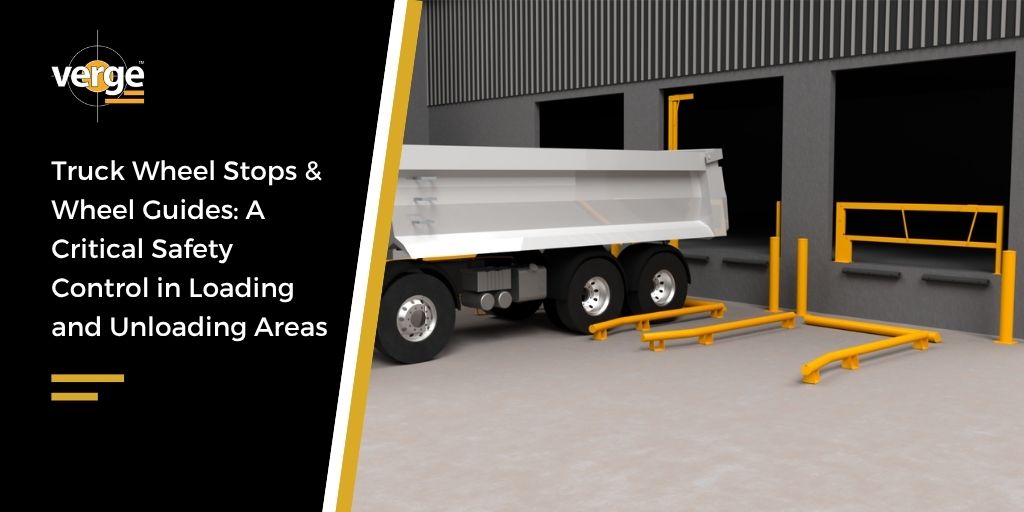
Truck wheel stops are physical devices positioned to limit the forward or rearward movement of a vehicle once it reaches a designated position. Wheel guides perform a related function by assisting the driver to position the vehicle accurately within a designated area.
Depending on the application, these controls may be used around: loading docks; distribution centres; warehouses; manufacturing facilities; logistics yards; waste facilities; construction sites; service areas; truck parking areas; delivery zones and other locations where heavy vehicles must be positioned consistently.
Their purpose may include controlling vehicle position, protecting infrastructure, defining parking or loading locations and reducing the likelihood of a vehicle travelling beyond the intended operating area.
However, their design and installation must be appropriate to the vehicles and activities involved. A wheel stop designed for a passenger vehicle is not automatically suitable for a heavy vehicle. That distinction is fundamental.
A truck is not simply a larger car. The mass of a heavy vehicle, together with its speed, braking characteristics, load and operating environment, means that a physical control must be capable of performing its intended function under foreseeable conditions.
SafeWork NSW expressly notes that truck wheel stops can be installed and designed to withstand the weight of heavy vehicles and mobile equipment when driving and reversing into parking and loading/unloading areas.
This creates an important safety-management principle:
The control must be designed for the hazard it is intended to control.
This distinction is critical.
SafeWork NSW identifies vehicle immobilisation as a specific high-risk issue and recommends measures to ensure trucks cannot move during loading and unloading. Depending upon the circumstances, these may include handbrakes, stabilisers, dock locks, air-brake isolation/interlock devices, barriers or other controls.
Therefore:
A wheel stop should not be treated as the primary means of preventing vehicle movement during loading or unloading unless the specific system has been designed and assessed for that purpose.
The consequences of getting this wrong can be severe.
A vehicle that unexpectedly moves can crush or trap a person between the truck and: a loading dock; another vehicle; a forklift; a wall; a fixed structure; stored materials; or other plant and equipment. These are foreseeable crush and struck-by hazards.
Loading and unloading activities bring together multiple hazards.
SafeWork NSW identifies loading and unloading as a high-risk activity and recommends a work plan, appropriate exclusion zones, driver information and training, effective communication and measures to prevent workers being positioned between the load and truck or other equipment.
This is why wheel guides and stops should be considered as one component of the overall system.
One of the strongest principles in traffic management is to separate people from vehicles wherever reasonably practicable. SafeWork NSW recommends clearly defined pedestrian-only and vehicle-only areas and the use of fixed and secured barriers where appropriate.
Safe Work Australia similarly recommends identifying areas where people and vehicles interact and considering vehicle types, loading and unloading areas, parking, vehicle entry and exit points, blind spots and visibility.
This means that a loading area should not be designed simply around: “Can the truck get in and out?”
It should also ask: “Can the truck get in and out without exposing workers and pedestrians to unnecessary risk?”
That is a very different design question.
Wheel guides may be particularly useful where vehicles need to be positioned accurately.
Correct positioning can assist with:
Predictability is an important element of safety. Where every driver positions a vehicle differently, workers may be exposed to varying gaps, blind spots, access points and vehicle movements.
A well-designed system creates a more consistent operating environment. However, the guide itself must not create a trip hazard, impact hazard or obstruction.
This is where competent risk assessment is essential.
SafeWork NSW cautions that selecting an inappropriate traffic control can increase risk, including by affecting vehicle stability.
Before installing wheel stops or guides, consider:
These questions should be documented as part of the risk assessment.
Reversing remains one of the most significant traffic-management risks in workplaces.
SafeWork NSW states that the most effective way to reduce reversing incidents is to eliminate the need to reverse by introducing one-way systems wherever practicable. Where reversing cannot be avoided, businesses should consider barriers, designated reversing areas, exclusion zones, communication systems and vehicle warning or proximity-detection devices.
A wheel guide does not eliminate the reversing hazard. It may assist the driver to position the vehicle, but it does not eliminate: blind spots; pedestrians; forklifts; other vehicles; poor visibility; driver error or unexpected movement. Where reversing is necessary, the entire movement should therefore be controlled.
A physical control should be supported by clear site instructions.
Drivers should know: where they are required to enter; where they are required to stop; the designated loading area; the traffic flow; pedestrian exclusion zones; speed requirements; reversing requirements; who controls the loading/unloading operation; where they must wait and when it is safe to leave.
SafeWork NSW recommends that delivery drivers receive site-specific information, including restrictions on vehicle types, delivery times, loading/unloading areas, traffic-management plans, site induction requirements and relevant safety procedures.
A control that the driver does not understand is unlikely to be an effective control.
Installing a wheel stop or guide is not the end of the process. Like any physical safety control, it should be inspected and maintained.
Consider checking for: cracking; corrosion; movement; damaged anchors; deterioration of the supporting surface; impact damage; deformation; missing components; visibility and markings; and changes to the surrounding traffic environment.
The inspection frequency should reflect the level of risk and frequency of vehicle interaction.
A heavily used distribution centre will require a different inspection regime from a small workplace receiving one delivery per week. The control must remain effective for as long as the risk exists.
Workers, drivers, forklift operators, supervisors and other people involved in the operation should have an opportunity to contribute to the design and review of traffic controls. They may identify practical issues that are not immediately apparent from a drawing or site inspection.
Safe Work Australia specifically recommends asking workers, drivers and pedestrians about traffic-management problems they have encountered and reviewing incidents and near misses.
This is particularly important when introducing a new wheel-stop or wheel-guide system.
Ask the people who use it:
If the answer to these questions is no, the control requires review.
From a safety perspective, the installation of a truck wheel stop or wheel guide would not be regarded as evidence by itself that the risk has been adequately managed. The real test is whether the whole traffic-management system works.
That means considering vehicle movement + vehicle positioning + immobilisation + pedestrian separation + reversing + loading/unloading + communication + supervision + maintenance.
Each element has a role. No single device should be expected to solve a complex traffic-management problem.
Truck wheel stops and wheel guides can be valuable engineering controls when properly selected, designed, installed and maintained. But they must be treated as part of a broader WHS system.
The legal responsibility remains with those who have management or control of the workplace, plant and work activities. The objective is not simply to stop a truck at the correct point.
The objective is to ensure that the truck can arrive, position, load, unload and depart without creating an unacceptable risk to workers, drivers, contractors, visitors or members of the public.
That requires more than a piece of steel or concrete fixed to the ground.
It requires risk assessment, engineering, traffic management, consultation, supervision and ongoing review.
That is effective safety management.

*Applies to online orders only. *Cannot be used in conjunction with any other offer **Must purchase within 3 months of receiving the voucher ***Minimum order $1000
"*" indicates required fields
If you need assistance with selecting a product, would like a quote or want to ask a question please call our friendly team on 1800 765 539