

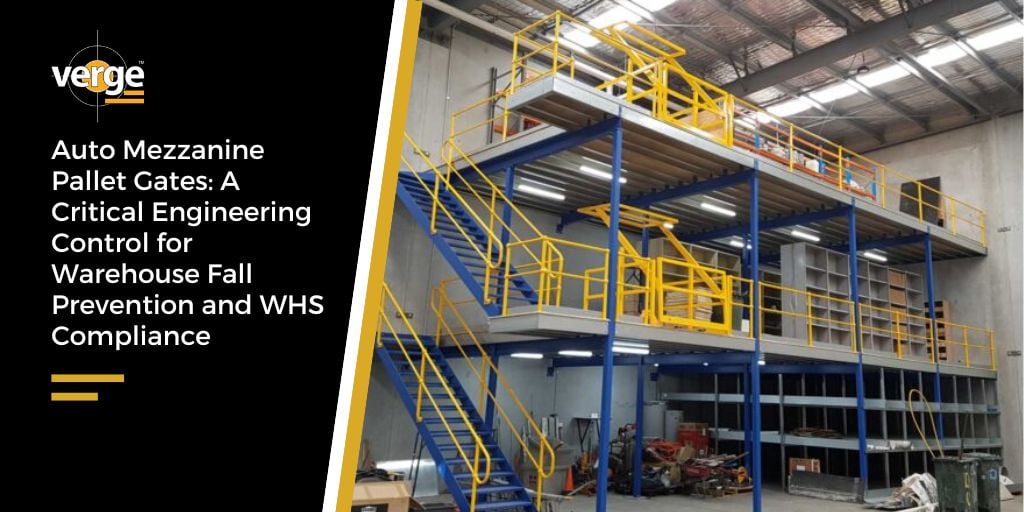
Warehousing, logistics and manufacturing facilities continue to evolve with increased automation, higher storage demands and faster material handling processes. While mezzanine floors provide valuable operational efficiencies and maximise storage capacity, they also introduce one of the most significant risks within industrial workplaces; falls from height.
Every year, workplace incidents involving unprotected edges, loading zones and elevated platforms contribute to serious injuries and fatalities across Australia and internationally. In many cases, these incidents occur during routine pallet loading and unloading activities where workers are exposed to open mezzanine edges while forklifts transfer materials between levels.
Entire Shopfitting Pty Ltd was fined $300,000 after a worker died in a fall from an unguarded mezzanine when a ladder broke through a hole in the floor. The incident highlights the critical importance of fall prevention measures, edge protection, and safe systems of work when working at heights.
Auto mezzanine pallet gates have emerged as one of the most effective engineering controls for managing these risks. Their purpose is not merely operational convenience. They are designed to ensure continuous edge protection during pallet transfer activities and eliminate situations where workers may be exposed to unguarded drops.
For Persons Conducting a Business or Undertaking (PCBUs), officers, directors and warehouse managers, understanding the legal obligations, risk management requirements and operational benefits associated with mezzanine pallet gates is essential.
An auto mezzanine pallet gate is a dual-action or counterbalanced safety gate system installed at mezzanine loading points where pallets are transferred between floor levels using forklifts or pallet handling equipment.
The key function of the gate is to maintain continuous fall protection during loading and unloading operations. Unlike chains, removable rails or manually operated barriers that may be left open, a properly designed pallet gate ensures that one protective barrier remains closed at all times.
The system generally operates through a counterbalanced mechanism:
This design significantly reduces the likelihood of workers being exposed to open mezzanine edges.
Modern pallet gate systems may include:
The operational objective remains the same, ensuring there is never an exposed edge during pallet transfer activities.
Under the harmonised Work Health and Safety Act adopted throughout most Australian jurisdictions, PCBUs have a primary duty to ensure, so far as is reasonably practicable, the health and safety of workers and others.
This includes obligations to:
In warehouse environments, mezzanine loading points are considered high-risk areas due to the combination of:
Where there is a risk of a person falling from one level to another, WHS Regulations require duty holders to manage those risks using the hierarchy of control.
Importantly, the hierarchy prioritises engineering controls above administrative measures.
This means that relying solely on: procedural controls, warning signage, verbal instructions, exclusion zones or worker behaviour
These may be insufficient where an engineered solution such as an auto mezzanine pallet gate is reasonably practicable.
Failure to implement appropriate fall protection controls can expose businesses and officers to enforcement action, improvement notices, prohibition notices and prosecution.
One of the most common compliance failures observed in warehouse environments is the continued reliance on chain barriers or simple swing gates.
These systems create significant risks because they depend heavily on worker behaviour and procedural compliance. In practice, barriers are often: left open, bypassed, damaged, improperly secured or removed for operational convenience.
Industry guidance consistently identifies open mezzanine edges as one of the highest-risk areas in industrial workplaces.
Unlike passive barriers, auto pallet gates are specifically designed to prevent the edge from remaining unprotected.
This distinction is critical from both a risk management and legal perspective.
Where an incident occurs and it is identified that a more effective engineering control was reasonably available, the regulator may determine that the PCBU failed to eliminate or minimise risk so far as reasonably practicable.
Warehouse mezzanine loading zones involve multiple interacting hazards.
The most significant hazard is worker exposure to unprotected edges during pallet transfer activities.
Falls from elevated platforms can result in:
Improperly secured pallets or unstable loads may fall from mezzanine edges and strike persons below. Even relatively lightweight materials can cause catastrophic injury when falling from height.
Forklift movements near mezzanine edges increase the risk of:
Administrative controls alone rely on workers consistently following procedures under operational pressure. Fatigue, distraction, production demands and complacency increase the likelihood of procedural failures.
Poorly designed mezzanine systems or concentrated pallet loading may create structural loading concerns if weight distribution is not adequately controlled.
Not all pallet gate systems are equal.
PCBUs should ensure the selected system is appropriate for:
Factors to consider include:
Load Size Compatibility: Some gates are designed for standard pallets only, while others accommodate oversized or tall loads.
Durability: Industrial environments require systems capable of withstanding repetitive use and potential forklift interaction.
Corrosion Resistance: Galvanised or powder-coated systems may be necessary in harsh or external environments.
Ease of Operation: Complex systems may encourage workers to bypass procedures.
Maintenance Requirements: Regular inspection and preventative maintenance programs should form part of the WHS management system.
Compliance With Relevant Standards: Systems should align with applicable Australian standards, guardrail requirements and manufacturer specifications.
Installing a pallet gate is not the end of the compliance obligation.
PCBUs must ensure the system remains: functional, structurally sound, properly maintained and fit for purpose.
Inspection programs should include:
Any damaged or malfunctioning system should be isolated until repaired. Maintenance records should also be retained as evidence of due diligence and ongoing WHS management.
Officers and directors cannot assume that operational safety is solely a warehouse-level responsibility. Under WHS legislation, officers must exercise due diligence to ensure the organisation complies with its obligations.
This includes taking reasonable steps to:
Failure to address known fall hazards at mezzanine loading areas may expose officers to personal liability where reasonably practicable controls were available but not implemented.
Auto mezzanine pallet gates are far more than a warehouse accessory. They are a critical engineering control designed to eliminate one of the most serious risks in industrial environments; falls from height during pallet transfer operations.
As warehousing operations continue to increase in complexity and pace, businesses must move beyond outdated controls such as: chains and removable barriers that rely heavily on worker behaviour.
Modern WHS expectations require proactive risk elimination wherever reasonably practicable.
For PCBUs, officers and facility managers, investing in properly designed mezzanine pallet gate systems demonstrates a commitment to:
Most importantly, these systems help ensure workers return home safely at the end of every shift.

*Applies to online orders only. *Cannot be used in conjunction with any other offer **Must purchase within 3 months of receiving the voucher ***Minimum order $1000
"*" indicates required fields
If you need assistance with selecting a product, would like a quote or want to ask a question please call our friendly team on 1800 765 539