

Forklifts remain one of the most essential pieces of plant and equipment within warehouses, distribution centres, manufacturing facilities and logistics operations throughout Australia. However, while considerable attention is placed on forklift operation, pedestrian interaction and traffic management, one critical risk area is frequently underestimated: forklift battery charging.
Charging electric forklifts involves a combination of electrical hazards, hazardous chemicals, hydrogen gas generation, manual handling risks and fire hazards. Without appropriate controls, charging stations can become a significant source of workplace incidents, property damage and serious injury.
In many workplaces, charging activities are treated as routine maintenance tasks rather than high-risk work processes requiring structured safety controls. Workers may connect or disconnect batteries without proper personal protective equipment (PPE), charge batteries in poorly ventilated areas or fail to identify signs of battery deterioration and overheating.
Under Work Health and Safety (WHS) legislation, Persons Conducting a Business or Undertaking (PCBUs) have a legal obligation to ensure, so far as is reasonably practicable, the health and safety of workers and others who may be affected by workplace activities.
This obligation includes ensuring forklift charging systems, battery handling procedures and charging environments are safe, properly maintained and effectively managed.
Charging your forklift safely is not simply a maintenance requirement. It is a critical component of workplace risk management and legal compliance.
Most electric forklifts operate using lead-acid batteries, although lithium-ion technology is increasingly being adopted in modern fleets. Both battery types present specific hazards that require appropriate management.
Lead-acid batteries emit hydrogen gas during charging. Hydrogen is highly flammable and can become explosive when allowed to accumulate in confined or poorly ventilated areas.
A small ignition source such as a spark, static electricity, smoking materials, electrical faults or incompatible equipment may trigger a fire or explosion.
Hydrogen gas is particularly dangerous because it is colourless, odourless and difficult to detect without monitoring systems.
Safe Work Australia identifies flammable atmospheres and ignition sources as significant hazards requiring appropriate controls in workplaces involving hazardous chemicals and plant. See the Safe Work Australia model code of practice for further guidance.
Lead-acid batteries contain sulfuric acid which can cause severe skin burns, eye injuries, respiratory irritation, clothing damage and environmental contamination.
Battery leaks, overfilling or damaged casings may expose workers to hazardous substances during charging or maintenance activities. Even minor splashes can result in significant injury where workers are not wearing appropriate PPE.
Forklift charging systems involve high electrical currents and direct current (DC) power systems. Potential risks include electric shock, arc flash incidents, damaged cables, faulty charging equipment, exposed terminals and improper isolation procedures.
Electrical incidents may result in serious injury, burns or fire. In August 2011, an employee received an electric shock while plugging in a battery-operated forklift for charging. Although he received medical treatment, he died six days later from the effects of the shock.
Forklift charging areas may contain multiple ignition sources combined with combustible materials such as cardboard, pallets, packaging, oils, flammable liquids and waste materials. Overheating batteries or chargers can initiate fires that spread rapidly within warehouse environments.
Forklift batteries are extremely heavy and may weigh several hundred kilograms. Improper battery handling during replacement or maintenance may expose workers to crush injuries, musculoskeletal injuries, pinch-point hazards and dropped load incidents. Mechanical lifting systems and battery handling equipment may be required to minimise these risks.
Under the harmonised Work Health and Safety Act and Regulations, PCBUs must ensure, so far as is reasonably practicable:
Forklift charging activities involve multiple overlapping legal duties relating to:
Importantly, officers and directors also have due diligence obligations requiring them to ensure appropriate resources and systems are implemented to manage these risks effectively.
Failure to adequately manage charging hazards may expose organisations and individuals to:
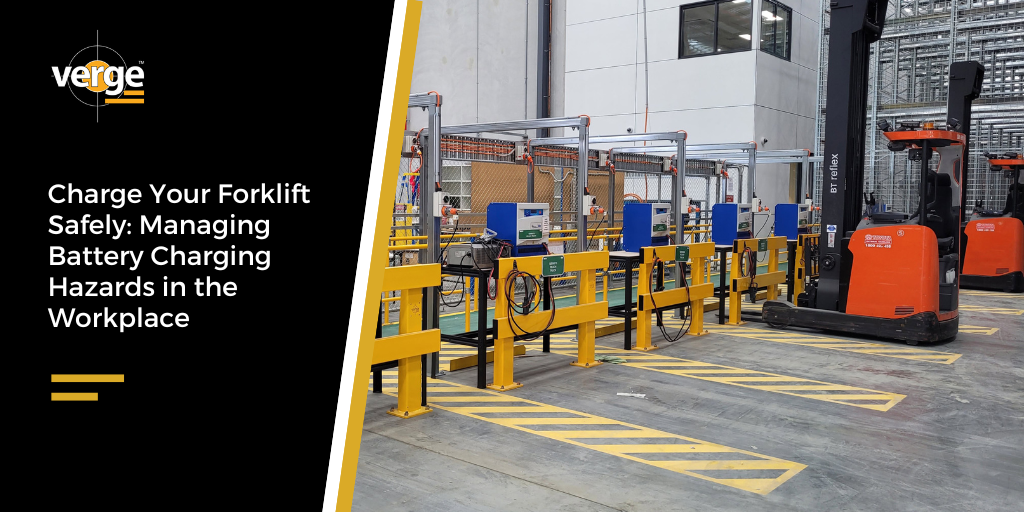
One of the most important controls is establishing a designated forklift charging station specifically designed for battery charging activities. Charging should never occur randomly throughout the workplace. A compliant charging area should include the following considerations.
Ventilation is critical to prevent hydrogen gas accumulation. Charging stations should be located in well-ventilated areas that allow gas dispersal. In some environments, mechanical ventilation systems may be necessary to maintain safe atmospheric conditions. Poor ventilation significantly increases explosion risks.
Guidance from industry safety authorities emphasises the importance of adequate airflow and ignition source control in battery charging environments, as outlined in the Managing Risks of Hazardous Chemicals in the Workplace Code of Practice 2021.
Charging areas should be isolated from:
Appropriate signage prohibiting smoking and ignition sources should be clearly displayed.
Charging stations should include:
Workers must also be trained in emergency response procedures.
Chargers should be:
Damaged charging leads or connectors should be removed from service immediately.
Many organisations are transitioning to lithium-ion forklift batteries due to faster charging times, reduced maintenance, longer operational life and improved efficiency. However, lithium-ion systems introduce unique hazards including thermal runaway, intense battery fires, toxic smoke release and specialised fire suppression challenges.
Unlike lead-acid batteries, lithium-ion battery fires may be difficult to extinguish and may reignite after initial suppression.
PCBUs adopting lithium-ion systems should ensure:
Many workplace charging stations continue to demonstrate recurring deficiencies, including:
These failures significantly increase both safety and legal exposure.
Forklift battery charging should never be treated as a routine or low-risk activity. Whether using traditional lead-acid systems or modern lithium-ion technologies, charging operations involve multiple serious hazards requiring structured risk management controls.
For PCBUs, officers, warehouse managers and supervisors, safe forklift charging practices form a critical component of workplace safety compliance, operational continuity and due diligence obligations.
A properly designed charging station supported by effective procedures, competent workers, regular maintenance and strong supervision can significantly reduce the risk of fire, explosion, chemical injury, electrical incidents and environmental harm.
Most importantly, it helps ensure workers remain protected while carrying out essential operational tasks.
Safety in the workplace is not achieved through assumptions or convenience. It is achieved through proactive planning, effective controls and a commitment to continuous risk management. For further guidance on safe forklift charging practices, visit Energy Safe Victoria.
For compliant charging station solutions designed for Australian workplaces, contact the team at Verge Safety Barriers.

*Applies to online orders only. *Cannot be used in conjunction with any other offer **Must purchase within 3 months of receiving the voucher ***Minimum order $1000
"*" indicates required fields
If you need assistance with selecting a product, would like a quote or want to ask a question please call our friendly team on 1800 765 539