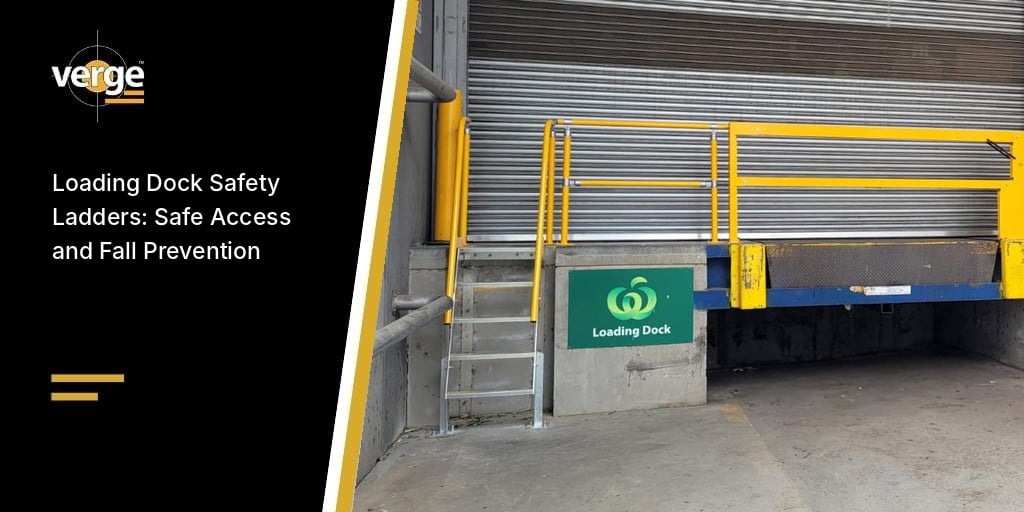


A loading dock is a workplace designed to move goods efficiently. It is not, however, designed to be a shortcut. Every day, workers, drivers, contractors and visitors may be required to move between the warehouse floor, loading dock, truck tray, trailer or other elevated surfaces. Where there is a difference in level, there is a potential fall hazard.
One of the simplest and most overlooked controls is the provision of safe, purpose-designed access including appropriately designed loading dock safety ladders where a ladder is the appropriate control.
The critical issue is not whether a ladder has been provided. The issue is whether the means of access is safe, suitable for the task and designed to prevent foreseeable falls.
SafeWork NSW specifically identifies loading docks as locations where falls can occur during loading operations and when the dock is not in use. Its guidance states that workers should not gain access to loading bays by jumping on or off the dock and recommends providing steps at a convenient location to encourage safe access.
That principle comes first: if workers need to move between levels, provide a safe way for them to do it.
The provision of a ladder is not simply an equipment decision. It is part of the PCBU’s broader obligation to manage risks to health and safety.
The Work Health and Safety Act 2011 (NSW) requires a person conducting a business or undertaking (PCBU) to ensure, so far as is reasonably practicable, the health and safety of workers and other persons who may be affected by the undertaking.
The concept of “reasonably practicable” is important. It requires consideration of matters including the likelihood of the risk occurring, the degree of harm that could result, what is known about the hazard and ways of eliminating or minimising the risk, the availability and suitability of ways to control the risk and the cost of those controls. SafeWork NSW confirms that this standard applies to duties under both the WHS Act and the current WHS Regulation 2025.
Consequently, the question should never be: “What ladder can we buy?”
It should be: “What is the safest reasonably practicable method of providing access to this loading dock?”
That may be a fixed ladder, a stairway, a purpose-designed access platform or another engineered access solution. The control should be determined by the risk not by what happens to be available.
Loading docks create an unusual combination of hazards. There may be an elevated dock edge, trucks and trailers positioned immediately adjacent to the dock, gaps between the dock and vehicle, forklifts operating in the area, pedestrians moving through the loading zone, wet or contaminated surfaces, uneven surfaces, changing vehicle positions, limited lighting, reversing vehicles, open dock edges when no vehicle is present and workers carrying goods or equipment.
A worker who attempts to climb onto a dock, truck or trailer using an unsuitable ladder or, worse, by climbing on the vehicle itself may be exposed to a fall, crush injury or struck-by incident.
SafeWork NSW specifically advises that workers should not jump on or off-loading bays and that safe access should be encouraged by providing steps at a convenient location. This is an important distinction. The safest access point is the one the workers will use.
If the designated access is inconvenient, obstructed or located too far from the normal work activity, workers may create their own access route. That is a foreseeable behaviour that good safety management should anticipate.
The hierarchy of control requires PCBUs to consider whether the hazard can be eliminated or controlled using a higher-order measure.
SafeWork NSW advises that work should, wherever possible, be performed from ground level and that ladders should generally be used only for simple access jobs or short duration work where safer alternatives are not reasonably practicable. This is particularly relevant to loading docks.
If workers are routinely moving between two levels throughout the day, repeatedly carrying materials, entering and exiting trailers or performing extended tasks, a portable ladder may not be an appropriate long-term access solution.
A properly designed stairway or fixed access system may provide a substantially safer and more practical control taking the following into consideration:
The answer should therefore be based on a risk assessment of the actual work activity.
Where a fixed ladder is determined to be appropriate, it should be designed, constructed and installed to provide safe access.
Safe Work Australia’s Code of Practice: Managing the risk of falls at workplaces states that fixed ladders should be installed in accordance with AS 1657 – Fixed platforms, walkways, stairways and ladders – Design, construction and installation.
The design must consider the environment in which the ladder will be used.
This includes ladder position, access and egress, climbing angle, landing arrangements, handholds, clearances, slip resistance, surrounding hazards, fall protection, structural integrity and the intended users and frequency of use.
The ladder should not simply be attached to the side of a dock because there happens to be sufficient space.
The access system should be designed as part of the workplace.
One of the most important areas of a fixed ladder is often the point where the worker steps onto or off the elevated surface. This transition creates a potential fall exposure.
SafeWork NSW guidance states that where single or extension ladders are used for entry and exit, there should be a firm and stable platform free from obstructions, the ladder should be securely fixed, and the ladder should extend at least 1 metre above the stepping-off point. It also identifies the need for fall protection at the stepping-off point where appropriate.
This principle should not be overlooked. A ladder may be perfectly secure during the climb but still expose a worker to a fall when transferring onto the dock. The transition point needs to be considered as part of the complete access system.
The ladder does not control the entire loading dock. The dock edge itself remains a hazard. When a vehicle is not correctly positioned, or when the loading bay is empty, an unprotected dock edge may expose workers to a fall.
SafeWork NSW states that loading docks should have appropriate edge protection where there is an unprotected gap at the sides of the vehicle and that when the loading bay is not in use, the area should be secured or the edge protected by a temporary barrier.
This raises a critical safety question: What happens when the truck leaves?
If the answer is simply “the ladder remains there”, the risk assessment is incomplete.
The loading dock must be safe during:
One of the most dangerous practices around loading docks is using the truck itself as a means of access.
Workers may climb onto truck trays, trailer drawbars, mudguards, wheels, chassis components, side rails or other vehicle structures.
Convenience must not be allowed to override risk control.
Loading docks are rarely quiet environments. Forklifts, pallet jacks, trucks and other mobile equipment may operate around the same access points.
SafeWork NSW identifies the need to consider workplace facilities, entry and exit arrangements and the separation of pedestrian and mobile-equipment movement. It states that separate entries and exits are required for mobile equipment such as forklifts and trucks, and that aisles and walkways should be kept clear and appropriately marked.
Accordingly, the location of the ladder matters just as much as the ladder itself.
A loading dock ladder should be included within the workplace inspection and maintenance system.
Inspection should consider structural damage, corrosion, loose fixings, damaged rungs, worn or slippery surfaces, damaged handholds, obstruction, lighting, surrounding floor condition, dock-edge protection, impact damage from vehicles or forklifts and changes to the surrounding work environment.
SafeWork NSW recommends that ladders be inspected and that defective ladders be removed from service.
However, the inspection should not stop at the ladder.
Ask: Is the access system still fit for purpose?
Workers will generally choose the easiest and quickest method of completing a task. This is not necessarily negligence. It is human behaviour.
If workers are expected to walk 30 metres to access a ladder while the truck is directly beside them, the business should not be surprised when someone climbs onto the truck instead. Effective safety management considers the way work is performed, not merely the way it is described in a procedure. This is why consultation is important.
SafeWork NSW encourages businesses to inspect workplaces and talk with the workers performing the work to identify fall hazards, including routine and non-routine activities.
Ask workers:
These answers may reveal risks that are invisible from a desk.
The current Work Health and Safety Regulation 2025 (NSW) contains specific requirements relating to fall risks.
Where a fall risk covered by the Regulation cannot be eliminated, section 79 requires the PCBU to minimise the risk by providing adequate protection. The Regulation identifies a safe system of work and gives examples including fall-prevention devices, work-positioning systems, fall-arrest systems, safe work procedures and the safe use of ladders.
The important point is that a ladder is not itself proof of compliance. The system surrounding its use must adequately control the risk.
As a safety professional, I would ask the following questions when reviewing a loading dock:
1. Is there a fall risk?
2. Can the need to work at height or access an elevated area be eliminated?
3. If not, can a safer access system be provided?
4. Is a fixed ladder appropriate for the frequency and nature of the task?
5. Is the ladder designed and installed appropriately?
6. Is the stepping-off point protected?
7. Is the loading dock edge protected when the truck is absent?
8. Are pedestrians separated from forklifts and trucks?
9. Is the ladder protected from vehicle impact?
10. Is the access route kept clear?
11. Is the ladder inspected and maintained?
12. Have workers been consulted about the actual method of access?
If any of these questions cannot be answered satisfactorily, the risk assessment should be revisited.
A loading dock ladder may look like a simple piece of infrastructure. It is not.
It is part of a system that allows workers to move safely between levels in an environment where vehicles, mobile plant, elevated surfaces and moving loads may all be present.
The legal responsibility is not discharged simply because a ladder has been purchased and installed.
The business must demonstrate that the means of access is suitable, maintained and reasonably practicable for the work being performed.
The safest approach is straightforward:
And, most importantly:
Do not wait until someone falls before deciding that the loading dock access system was inadequate.
Good safety management means identifying the foreseeable risk, implementing the appropriate control and verifying that the control continues to work.
If you’re reviewing how people get on and off your loading docks, Verge Safety Barriers can help. Book a free site appraisal and we’ll look at your traffic flow, your dock edges and your access points, then give you a clear recommendation and quote.
Call 1800 765 539 or contact us through the Verge Safety Barriers website. You can also download our loading dock safety mini brochure.

*Applies to online orders only. *Cannot be used in conjunction with any other offer **Must purchase within 3 months of receiving the voucher ***Minimum order $1000
"*" indicates required fields
If you need assistance with selecting a product, would like a quote or want to ask a question please call our friendly team on 1800 765 539