

In industrial environments, the interface between people and machinery is one of the most critical risk points within any operation. Where there is movement, force, automation and human interaction, there exists the potential for serious injury or fatality.
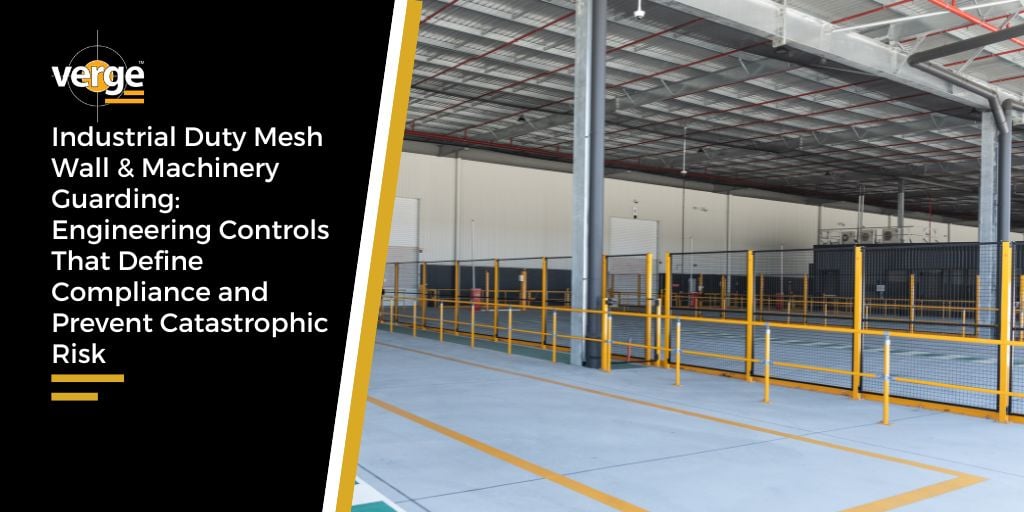
Industrial Duty Mesh Walls and Machinery Guarding are not optional infrastructure they are legally enforceable engineering controls that serve to isolate, contain and control hazardous energy.
Despite this, many organisations continue to rely on procedural controls, signage or operator experience as primary safeguards. This approach is fundamentally flawed.
Under the Work Health and Safety Act 2011, duty holders are required to eliminate risks so far as is reasonably practicable or where elimination is not possible, to minimise those risks using the highest level of control available.
Machinery guarding particularly through industrial mesh wall systems represents a primary risk control measure. Failure to implement it appropriately is not a gap in safety; it is a breach of duty.
Industrial duty mesh wall systems are engineered physical barriers designed to:
These systems are typically constructed from:
Their function is aligned with the principles outlined in Safe Work Australia, which emphasise that guarding must prevent access to danger zones during operation.
Machinery-related incidents remain one of the leading causes of serious workplace injuries. These incidents typically involve crushing, entanglement, shearing, impact injuries and amputation.
The common contributing factor is exposure either through inadequate guarding; removed or bypassed guards; poorly designed access points and failure to segregate workers from machinery
Where workers can physically access a hazard, the risk is not controlled.
Industrial mesh wall guarding addresses this risk by eliminating direct access, rather than attempting to influence behaviour.
Under the Work Health and Safety Act 2011, PCBUs must ensure, so far as is reasonably practicable:
Machinery guarding directly satisfies these obligations by removing the opportunity for worker exposure to hazardous plant.
The Work Health and Safety Regulations 2011 require that: plant must be guarded to prevent access to moving parts; guards must be of solid construction and securely mounted and guards must not introduce additional risk.
Failure to comply may result in improvement notices, prohibition notices, Significant financial penalties and prosecution.
The Managing Risks of Plant in the Workplace – Code of Practice provides clear guidance that: physical barriers are the preferred control method; guarding must be designed to prevent bypassing; and access must be controlled and monitored
Industrial mesh wall systems align directly with these expectations.
Hierarchy of Controls: Engineering Out the Risk
Within the hierarchy of controls, machinery guarding is classified as an engineering control, which ranks above: administrative controls (procedures, training) and personal protective equipment (PPE)
This is critical as administrative controls rely on human behaviour while engineering controls do not.
Mesh wall guarding physically prevents access, operates continuously and does not rely on decision-making under pressure. This is the distinction between compliance and exposure.
Not all guarding systems achieve compliance. For a mesh wall system to be effective, it must meet specific design criteria.
1. Prevention of Access.The system must: prevent reach-through, climb-over and walk-around access as well as, comply with safe distance requirements relative to hazard zones
2. Structural Integrity.Guarding must be impact-resistant, securely fixed and capable of withstanding operational forces. A compromised barrier is no barrier.
3. Controlled Access Points.Access gates must: be self-closing or interlocked, prevent operation of machinery when open and restrict unauthorised entry.
4. Visibility and Monitoring.Mesh systems provide clear line of sight for supervision and visibility of operations without exposure. This supports both safety and operational oversight.
5. Integration with Systems of Work.Guarding must integrate with lockout/tagout procedures, maintenance access protocols and emergency stop systems.
Industrial duty mesh wall systems are critical across multiple sectors, including:
In each of these environments, the interaction between human and machine presents a foreseeable and significant risk.
Where that risk is not controlled through guarding, the organisation is exposed.
Through practical application and audit, recurring failures include:
1. Incomplete Guarding
2. Removable or Bypassed Guards
3. Over-Reliance on Administrative Controls
4. Poor Maintenance and Inspection
Failure to implement effective machinery guarding has direct and significant consequences:
These consequences are not theoretical. They are well documented across industries.
Industrial mesh wall guarding is more than a compliance measure. It represents a commitment to protecting workers, a proactive approach to risk management and a visible demonstration of leadership
When workers see robust, well-maintained guarding systems, it reinforces a critical message:
Safety is engineered into the workplace – not left to chance.
Machinery guarding is one of the most fundamental requirements within workplace safety, as outlined under the AS 4024.1603:2019. Yet it is also one of the most frequently compromised.
Industrial duty mesh wall systems provide a practical, effective, and legally aligned solution to one of the most significant risks in any workplace. The expectation is clear, so is the legislation and the risk is foreseeable while the control is available.
The question for every workplace is not whether guarding is required. It is whether they are prepared to accept the consequences of not implementing it.

*Applies to online orders only. *Cannot be used in conjunction with any other offer **Must purchase within 3 months of receiving the voucher ***Minimum order $1000
"*" indicates required fields
If you need assistance with selecting a product, would like a quote or want to ask a question please call our friendly team on 1800 765 539