

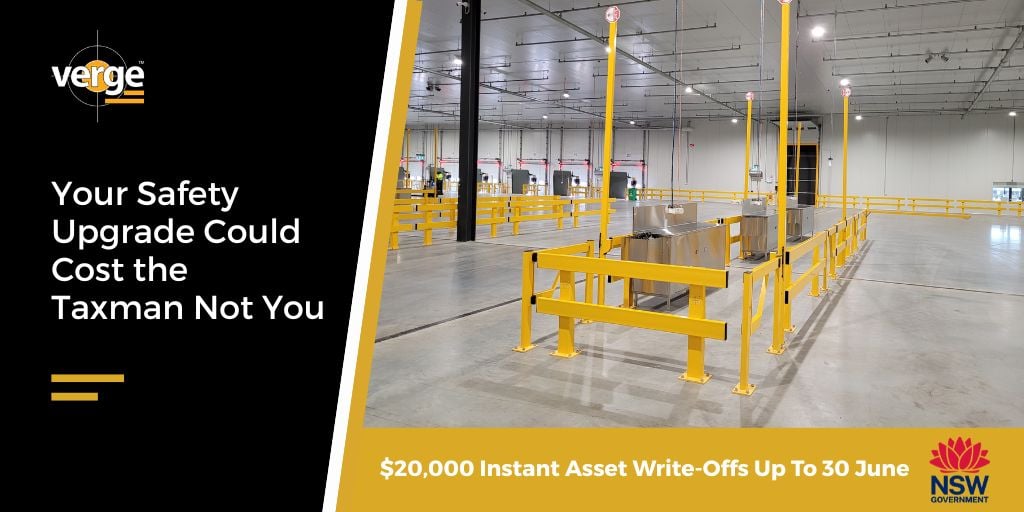
The federal government’s $20,000 instant asset write-off is active until 30 June 2026. If your business turns over less than $10 million a year and you’ve been putting off a safety upgrade, now is a genuinely good time to act.
WHS compliance isn’t optional. But the timing of how you invest in it can make a real difference to your tax position. That’s what this write-off is about.
Instead of depreciating the cost of an asset over several years, eligible small businesses can deduct the full purchase price in the same financial year. For a $15,000 barrier installation, that’s a $15,000 deduction this financial year, not spread across five or six.
The instant asset write-off lets eligible businesses claim an immediate tax deduction for the business portion of any qualifying asset that costs less than $20,000 (excluding GST) and is purchased and installed ready for use before 30 June 2026.
A few things worth knowing:
The key question is simple: does your project come in under $20,000? If it does, your business can claim the full cost as an immediate deduction in this financial year.
To give you a sense of what that looks like in practice, here are two examples of typical qualifying projects:
Example 1: Warehouse pedestrian safety – up to 75m of Verge Eco-Rail with pedestrian gates
A run of Eco-Rail handrail and a set of pedestrian gates creates a clearly defined walkway that separates foot traffic from forklift zones. This kind of installation typically falls comfortably within the $20,000 threshold and qualifies as a single project claim.
Example 2: Manufacturing workstation protection – up to 50m of Impact Polymer Barrier with pedestrian gates
Impact Polymer Barriers positioned around workstations and machinery protect both people and equipment. A typical installation of this size sits well under the $20,000 limit, making it a straightforward claim for the year it is purchased and installed.
These are illustrative figures. Exact costs depend on configuration, site conditions, and installation requirements. Request a quote and we can give you a specific number to take to your accountant.
| What this means in practice? If your project comes in under $20,000, you can claim it in full this financial year. No depreciation schedules. No spreading costs across five years. One deduction, this year. |
If you’ve been planning a safety upgrade and the budget has been the hold-up, it’s worth running the numbers with your accountant before the end of the financial year.
The key requirements are straightforward:
Note that “installed ready for use” is the trigger, not just the invoice date. If you order in June but installation happens in July, it won’t qualify for this financial year. Plan accordingly.
| What about larger projects? Assets costing $20,000 or more can still be added to the small business depreciation pool and written off over time at standard ATO rates. The instant write-off is one path, not the only one. |
We can help you work out what your facility needs and give you a clear quote to take to your accountant before the end of financial year. Whether it’s a single gate or a full barrier installation, we’ll get you the information you need to make the call.
Request a quote at vergesafetybarriers.com.au/request-a-quote or call 1800 765 539.
Always confirm your eligibility with a registered tax professional before purchasing. Tax rules change and individual circumstances vary.

*Applies to online orders only. *Cannot be used in conjunction with any other offer **Must purchase within 3 months of receiving the voucher ***Minimum order $1000
"*" indicates required fields
If you need assistance with selecting a product, would like a quote or want to ask a question please call our friendly team on 1800 765 539